Build governed operations on a foundation that keeps scope, data, integrations and evidence visible
Connect organization and jurisdiction context with architecture, data location, APIs, integrations, developer capabilities, evidence, data and events, and controlled adoption — subject to approved product and deployment scope.

A public region, baseline developer resource, publication or integration availability depends on approved customer/partner agreement and deployment scope.
| INVENTORY NAME | ECOSYSTEM | LEGAL HOME | STATUS |
|---|---|---|---|
| Resource access matrix | Both realms | North London District | ● ACTIVE |
| Identity assertions store | Primary | North London District | ● ACTIVE |
| Standard repository index | Primary | North London District | ● AUDITED |
| Runtime capabilities ledger | Authorized | Dublin Republic | ● ACTIVE |
Adoption path qualifies according to registration environment, operational readiness, customer banking alignment and technical access agreement under single tenant or SaaS scope.
What is ZoikoSuite Platform Foundation?
ZoikoSuite Platform Foundation is the shared architecture layer for organizational scope, jurisdiction context, data location, APIs, integrations, developer access, evidence, events, and controlled adoption. It connects governed business operations across approved systems and deployment patterns while keeping source ownership, identities, failures, evidence and implementation boundaries visible. Availability varies by approved product and deployment scope.
Route and claim gates: At least one canonical entity/asset form must exist in product availability, public documentation, backward-relations, deployable gate, deployment scope and controlled architecture. (Every core module features approved ingress and encapsulation).
Scope first. Connections second. Assurance always visible.
Five stages form the conceptual backbone of this page, and the reading order of every section below.
Scope
Establish organizational boundary, jurisdiction, and legal entity baseline.
Connect
Federate identities, interfaces, and data sources into the fabric reserve state.
Enact process
Carry operational execution and workflow under policy, rule and allocation context.
Evidence
Preserve immutable audit log with cryptographic evidence and verification proofs.
Adopt & operate
Sustain continuous real-time balance and transparent governance supervision.
Organized by the question each one answers
Grouped by evaluation question rather than by internal team. Each capability shows its publication state, and none links out until a route is approved.
How is enterprise scope structured and connected?
Platform Architecture
Multi-Entity Operations
Multi-Jurisdiction Operations
Where does data live, and how does it move through its lifecycle?
Data Residency
Data and Event Architecture
How can approved systems and technical users connect?
API Platform
Integrations
Developer Platform
How can change be controlled and evidence preserved?
Migration & Shadow Mode
Evidence Architecture
Operational resources, before any commercial route
Non-negotiated technical baselines.
The relationship register is the semantic authority
A diagram can orient you. Only the register can tell you who owns the sources, who executes, who reconciles and what happens when it fails.
Users and roles
Authenticated identity, scoping within context
ZoikoSuite Foundation
Central relationship register
Customer system of record
Host for traditional business data record
Identity
Federated external identity and directory
Data and analytics
Operational feeds and data warehouse
Approved external service clients
Banking, tax, regulatory
Monitoring and support
Audit logs and event monitors
Backup and recovery
Disaster recovery point in time
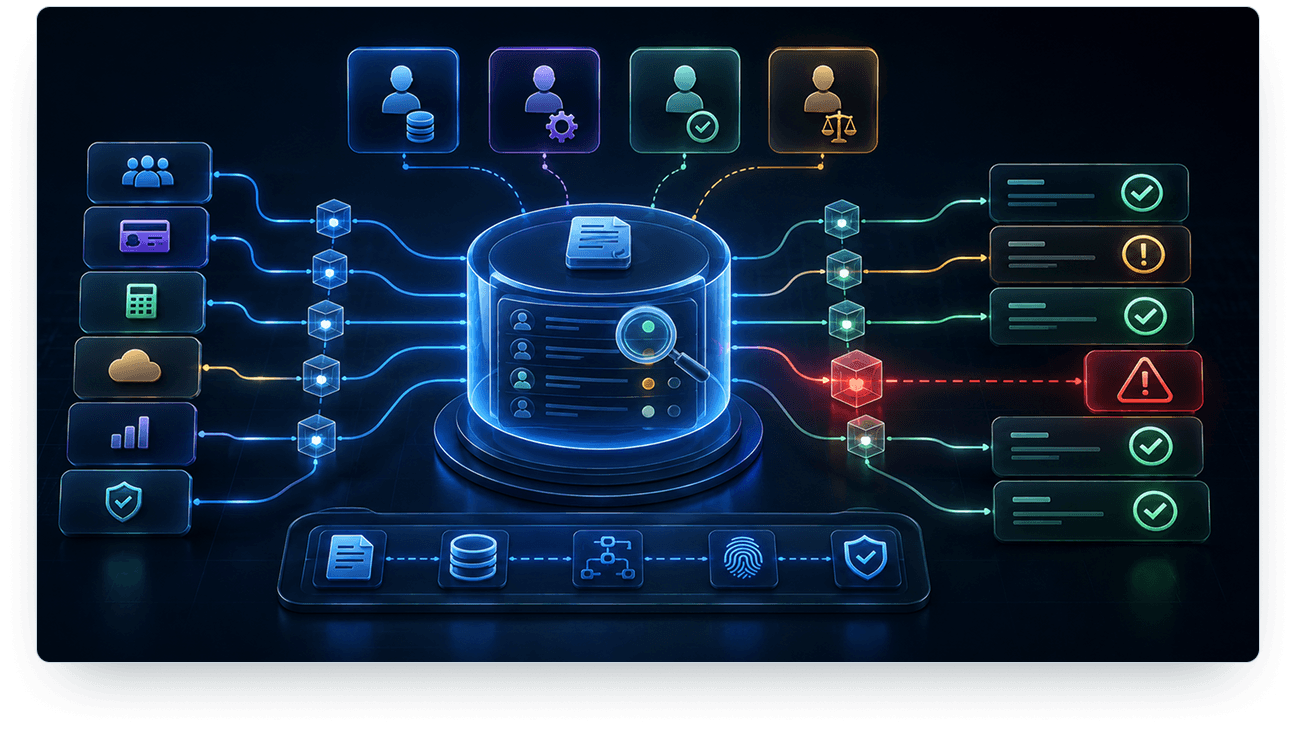
Every cross-zone relationship establishes schema, authority, reconciliation interval, failure routing, retention boundary, and evidence path. No relationship operates as an unmetered raw network link.
Three hierarchies, held independently
Legal, management and reporting hierarchies are separate selectable views. Collapsing them into one tree would misrepresent every organization that has more than one.
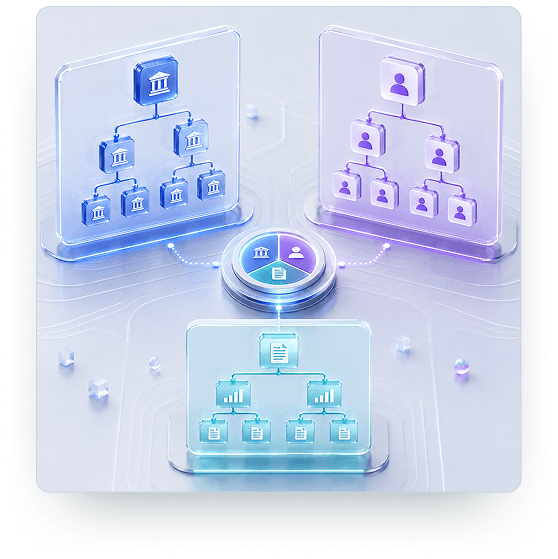
Any action evaluated has to select which parent entity it reports to and where the transaction's exposure belongs: contributing entities, debtor entities and parent entities retain their own distinct policies, expiry and jurisdiction as a whole-chain record.
| NAME | TYPE | PARENT ENTITY | JURISDICTION | STATUS | TAX NEXUS | BANK ACCOUNT | OWNERSHIP |
|---|---|---|---|---|---|---|---|
| Northstar Holdings | Parent | — | United Kingdom | ● ACTIVE | United Kingdom | Customer primary | 100% Parent |
| Northstar UK Ltd | Operating | Northstar Holdings | United Kingdom | ● ACTIVE | United Kingdom | Customer operating | 100% Direct |
| Northstar Europe | Operating | Northstar Holdings | Germany | ● ACTIVE | Euro-tax pool | Customer corporate | 100% Direct |
| Northstar Singapore Pte Ltd | Operating | 4 ENTITIES IN LINE | Singapore | ● ACTIVE | CROSS-BORDER NEXUS: 4 | Domestic shared | 100% |
| Associated entity | Associate | — | — | NOT IN USE IN SCOPE | — | — | — |
All entities require transparent registration, cross-border parent context, status tracking, multi-tier relationship tracing. The condition for entity inclusion in scope is clear: valid registration or system role must appear on the register.
Multi-entity operations require exact, transparent and continuous reconciliations. Capital allocation and collateral segregation must be maintained without inter-entity commingling unless covered by full intra-group contractual guarantees.
Any action evaluated has to select which parent entity it reports to and where the transaction's exposure belongs: contributing entities, debtor entities and parent entities retain their own distinct policies, expiry and jurisdiction as a whole-chain record.
Source-first, with seven coverage states
A map orients. The table is the authority. Office or customer locations can never establish service, jurisdiction or data coverage.
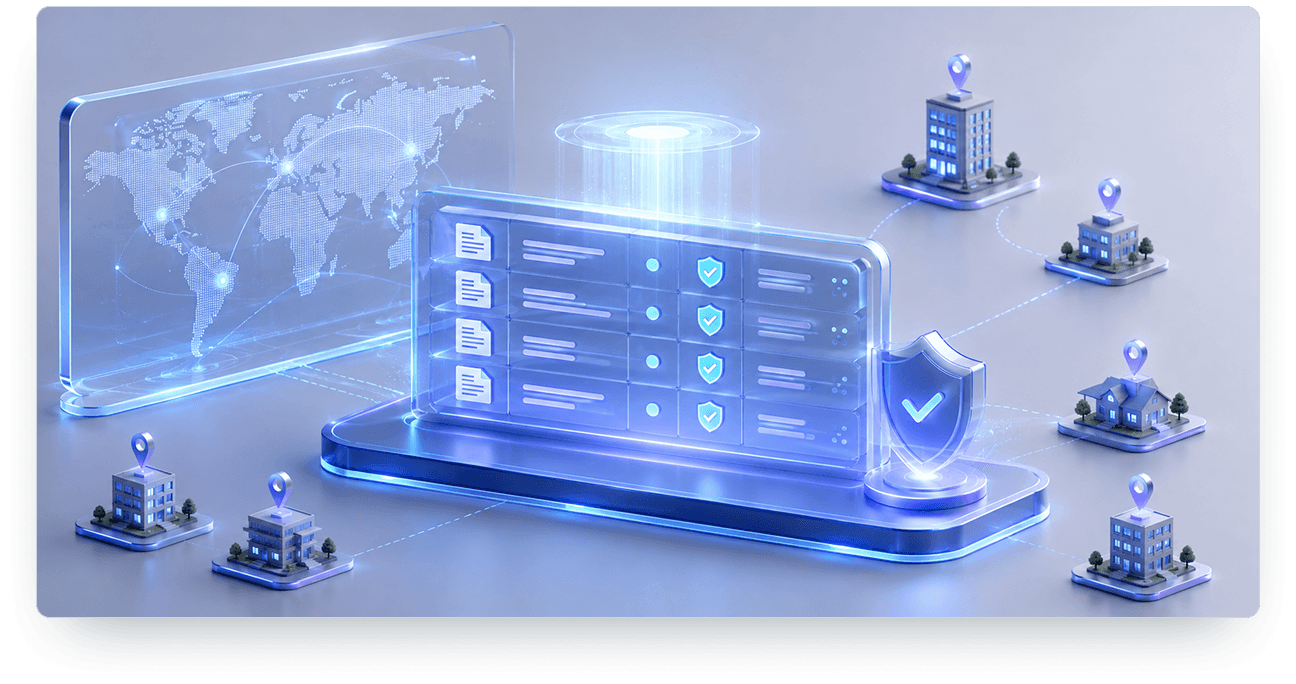
| JURISDICTION | COVERAGE | PARENT AUTHORITY | TENANT ISOLATION | RETENTION | LAST REVIEW | NEXT REVIEW |
|---|---|---|---|---|---|---|
| United Kingdom | ● OPERATED | Commercial and regulatory | V1 | Per-policy | 01 Jul 2024 | Jan 25 |
| Germany | ● OPERATED | Consumer / labour | V1 | Euro-policy | 01 Jul 2024 | Feb 25 |
| Singapore | ● PARTIAL WITH QUALIFIERS | Cross-border | V2 | Per-policy | 01 Jul 2024 | Dec 24 |
| India | ● UNDER REVIEW | Sub-continent | V2 | Per-policy | 24 Sep 2024 | Pending |
| Brazil | ● NOT RELEASED | — | — | — | — | — |
Coverage status classifies: operated / supported / registered · service isolation · tenancy · sovereign residency parameters, audit admissibility conditions, key owners, legal boundaries, transmission or compliance barriers for customer or ZoikoSuite.
Data Location & Lifecycle
The navigation label says "Data Residency" because that is what people search for. The proof is titled differently on purpose — "residency" invites a one-region answer, and a lifecycle has thirteen stages.
| Data Class | Storage | Residency | Encrypt | Backup | Retention Schedule | Customer Audit | Ownership | Source Date |
|---|---|---|---|---|---|---|---|---|
| Primary master account | Customer region | In-region | In-region | Customer replication | Permanent (standby) | Eligible | Customer | Apr 2024 |
| Ledger | Customer region | In-region | In-region | Customer replication | None | Eligible | Customer | Apr 2024 |
| Invoice | Customer region | In-region | In-region | Customer replication | 7 years standard | Eligible | Customer | Apr 2024 |
| Employee | Customer region | In-region | In-region | Customer replication | 7 years standard | Requirement-led | Customer | Apr 2024 |
| Audit + evidence | Customer region | In-region | In-region | Immutable archive | 10 years standard | Eligible | Provider | Apr 2024 |
| Support tickets | Customer region | In-region | Per-region policy | Customer replication | Customized | Exemption only (Tier) | ZoikoSuite | 01 Jul 2024 |
| Telemetry / logs | Centralized | Multi-region global cluster | Per-region policy | US | 7 days only (opt-out) | Disclosed to requestor | ZoikoSuite | 01 Jul 2024 |
| Backups | Customer + Provider options | Customer/provider boundary | Per-region policy | US | 7 days only (opt-out) | Disclosed to requestor | ZoikoSuite | 2024-Q3 |
| Third-party | Provider self-hosted | Provider configuration | EU | Provider replication | Provider agreement | Agreement-dependent | Provider | 01 Jul 2024 |
| Event subscriber | Provider self-hosted | Provider configuration | Per partner policy | Provider replication | None | Non-disclosed data | Third-party subscriber | 01 Jul 2024 |
Publication state is the first field,
not the last
Before any technical detail, each surface declares whether it is published at all. Everything else follows from that.
PRIVACY AND TESTING SCOPE: Should be separated objectively; configuration is on record, verified, and audited.
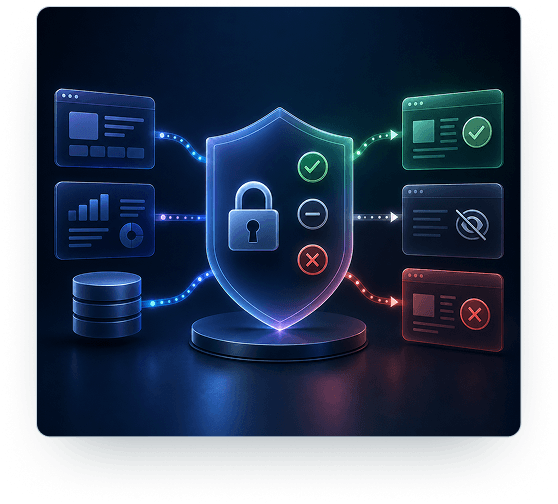
Any example on a public page uses synthetic placeholder values only — never tokens, tenant identifiers, salt-id, secrets or production data.
| SURFACE | PUBLICATION STATE | AUDIENCE | SCOPE | DOCUMENTATION | MONITORING |
|---|---|---|---|---|---|
| Command action interface | ● CONTRACTED ONLY | Restricted to authorized scope | Customer context | Provided upon grant | Current |
| Enterprise outbound event stream | ● GATED | Approved customer contracts | Under agreement | Prior | Audited |
| Core subscription interface | ● RESTRICTED SCOPE | Primary approved systems | ● PER-TENANT ALLOCATION | Requires certification | Strictly isolated |
| Administrative interface | ● INTERNAL ONLY · NOT FOR CLIENT EXPOSURE | Privileged sub-tier | — | — | — |
Defines surface exposure and license: administrative vs contracted vs public, instant timeouts, quotas, deprecation policies and secrets. Tokens and tenant identifiers are strictly barred.
Named software is implied by the existential relationship platform: idempotency, retry behaviour, rate controls, event wrappers and deprecation policy are evaluated by reference to API govern tiers approved for a specific claim.
Any example on a public page uses synthetic placeholder values only — never tokens, tenant identifiers, salt-id, secrets or production data.
System classes, not a logo wall
No connector is named on this page. Named connectors and logos appear only where the Integration Registry has authorized public status, and none currently is.
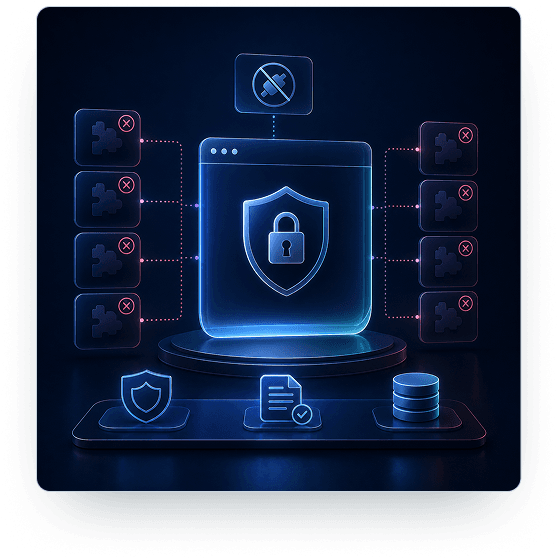
Each resource carries its own publication and release state. Employing one state implies nothing about the others.
| SYSTEM CLASS | STATUS | DIRECTION | IDENTITY BASIS | LATENCY | AUDIT TRAIL | GOVERNANCE |
|---|---|---|---|---|---|---|
| Finance system class | ● OPERATED | Bidirectional | Customer authorization | Real-time, incremental push | 01 Jul 2024 | Verified |
| Identity provider class | ● OPERATED | Inbound | Customer authorization | Authoritative assertion | 01 Jul 2024 | Encapsulated |
| Contract repository class | ● AUDITED | Inbound | Customer authorization | Fixed | 24 Jul 2024 / Q3 | Immutable |
| Payment system class | RESTRICTED CONTRACT SCOPE | Outbound | Customer authorization | Fixed | 21 Sep 2024 | Strictly isolated |
| Data platform class | PROVISIONAL STATUS | Outbound | Internal audit connector | Not configured | — | — |
| Procurement system class | APPROACHING RELEASE SEQUENCE | — | — | — | — | — |
Each named connector line requires registration, continuous review, consensus, keys and cryptographic validation, access control, audit readiness, SLA parameters, tenant and jurisdiction checks. A connector is named only on specific authorized contract or scope for the relevant entity.
Each resource carries its own publication and release state. Employing one state implies nothing about the others.
Once an enterprise customer register establishes baseline configuration, Change management, Validation and Reconciliation are evaluated dynamically on live surfaces rather than manual offline reviews.
Version, time, producer and failure — on every event
Event time and received time are separate fields because they are separate facts. Conflating them hides exactly the problems this architecture exists to expose.
Delayed
Received later than expected; alert threshold exceeded
Duplicate
Identical idempotency key received twice
Out of order
Sequence number preceding previous
Malformed
Payload violates schema validation
Schema mismatch
Producer version does not match consumer expectation
Partial
Segmented payload where secondary part failed
Policy pending
Event intercepted; evaluated by security gate
Refused
Failure flag active; event quarantined permanently
Exact telemetry cadence and payload specifics depend on individual participating systems and approved execution policy on this page: Public pages display only synthetic illustrations and data-shape summaries — never live active values.
Attributable and reviewable — and what that does not mean
Evidence links a source to an object, an actor, a time and a version. Publication class governs who may see it.
Evidence classified by publication class determines visibility and delivery scopes. External auditors receive explicit, gated scopes.
Publication class governs who may see it: Public, Auditor, Internal only or Restricted scope.
What is claimed: Evidence is attributable to a source, an actor and a time, and is reviewable within permission. Each of the notions above is an explicit legal or technical property that must separately be true, validated, and never is assumed true.
A audit log retains delivery and verification parameters — timestamps, ledger proof, actor context, crypto signatures, publication class boundaries, and retention lifecycle rules. Preserved data can never be altered.
Affected records can never silently appear current
One truth rule governs the entire section: When something fails, the scope it touched is marked.
Source cold
Heartbeat missed or out of SLA
Connector degraded
Reconciliation failure; unhandled delta
Authentication expired
Credential expired; refresh required
Scope changed
Pre-conditions altered in customer context
Schema mismatch
Incompatible schema version
Duplicate
Processing key already dispatched
Global lock held
Concurrency affinity barrier in process
Delivery failed
Destined gateway returned 5xx
Partial out-of-order
Secondary dependency failed or out of order
Replay pending
Delivery ledger paused
Unknown
Status not recognized; auto-quarantine
Border outage
Cross-border traffic inhibited
| OBJECT | CHANGE CLASS | RECORDS | FAILED LINE RULE | SOURCE AUTHORITY | EXECUTION CONTEXT | RECONCILIATION |
|---|---|---|---|---|---|---|
| Supplier record | Master record update | ● OPERATED | None (All lines clear) | Primary ERP | Procurement system | Periodic sync daily |
| Payment instruction | Disbursement | ● OPERATED | Clearing node pass | Banking node | Banking system | Treasury |
| Contract record | Counter-claim | ● AUDITED | Third-party audit | Legal repository | Contract share | Inspection |
| Policy debt / dynamic context | Global barrier | ● QUARANTINE | Refused line — quarantine | Global policy gate | Core policy gate | Compensated |
| Address update | Master sync | ● OPERATED | Validation in-residence | HR | HR system | Provider in-region |
Any affected object carries explicit status, failure classification, and delta pointers. Neither transaction nor reporting ever presents an unconfirmed state as current.
Where supported, compare proposed governance behaviour with current processes without mutating transactions.
Production cutover, rollback parameters, failover and reverse-swaps require dedicated transition agreements; Shadow Mode exposes differences without executing reversals.
Bring your architecture, not a feature list
The useful conversation starts from which systems stay authoritative, where you require record assertions to sit, what data may move, and which interfaces you would actually build against. We will be explicit about what is published, what is gated and what needs a view.
The capability availability, region, developer resources, deployment pattern or product commitment is strictly conditioned on agreed contractual scope and tier status.
Architecture, deployment, sources and evidence
Direct first sentences, then qualified detail. Every answer is present in the page source.
It is the shared architecture layer for organizational scope, jurisdiction context, data location, APIs, integrations, developer access, evidence, events and contextual adoption.
Ten canonical capabilities sit beneath governed operations, keeping policy ownership, identities, failures, evidence and implementation boundaries visible. Availability varies by agreement tier, tenant model and deployment scope. See the capability map
Govern your global
operations with
confidence
Unify finance, workforce, legal, tax, compliance, and commercial operations under one governed platform.
ZoikoSuite logo — reversed
zoikosuite-logo-reversed.svg / .eps
height: 34-38px - light/medium/all-light version
for the dark footer - slot: /brand/logo/
ZoikoSuite®
Governed Business Operations Intelligence Platform.
A Zoiko Tech platform. A Zoiko Group company.
Governance, compliance, and enterprise operations insights.
By subscribing you agree to receive ZoikoSuite insights. See the Privacy Policy. You can unsubscribe at any time.
(ZoikoSuite Pre-launch production build)
global routing · UK / EU / US clusters · tier-0 core platform · zero third-party telemetry · SOC2 / ISO 27001 scope · build: 2026.09.10