Why ZoikoSuite is not a conventional ERP
Conventional ERP products generally organize transactional modules and records. ZoikoSuite is designed to coordinate governed execution across functions, systems, entities, jurisdictions, policies, authority, evidence, and governed AI.

Is ZoikoSuite an ERP?
No. ZoikoSuite is not positioned as a conventional ERP. Conventional ERP products generally organize transactional modules and records, while ZoikoSuite is designed to coordinate governed execution across functions, systems, entities, jurisdictions, policies, authority, evidence, and governed AI. It may integrate with, complement, consolidate, or replace selected processes depending on approved implementation scope.
Organizes transactional modules, master data, ledgers, and operational records — often the authoritative source for finance and operations.
Individual ERP products vary widely in governance, workflow, analytics, and AI capability. Nothing here describes any specific product.
Organizes governed execution across those systems: context, policy, authority, approvals, segregation, evidence, exceptions, and governed AI around the action itself.
Scope depends on approved implementation, customer architecture, jurisdiction, and verified product availability.
Two organizing principles, seven dimensions
Every statement uses "typically" or "designed to." There are no checkmarks, scores, winner badges, price claims, or performance claims on this page.

The question is not "ERP or no ERP." It is where governed execution should live.
Organizations may have strong systems of record yet still coordinate approvals, obligations, policy decisions, evidence, and cross-functional exceptions through email, spreadsheets, tickets, and manual reconciliation.
Authority gaps
The system holding the transaction may not hold the complete delegated-authority and review context.
Cross-functional fragmentation
One event can affect finance, legal, tax, workforce, compliance, and procurement at once.
Evidence reconstruction
Reviewers assemble policy reasons, approvals, source documents, and decisions after the fact.
Change risk
Replacing a system of record may be unnecessary when the gap is governed coordination across systems.
Testable design properties, not a feature checklist
Select a difference to see the concrete screen, record, or state that demonstrates it. All six descriptions stay on the page.
Organizing principle
ERP commonly organizes modules and records. ZoikoSuite organizes governed actions and relationships across business objects and systems.
Governance placement
Controls are evaluated in the context of a proposed action — policy, jurisdiction, authority, approvals, segregation, and evidence together.
Cross-functional context
A single operational event can connect finance, workforce, legal, tax, compliance, procurement, and reporting consequences.
Evidence by default
Source records, policy reasons, reviewers, approvals, changes, exceptions, and outcomes remain attributable.
Governed intelligence
Analytics and AI operate within authorized sources, permissions, uncertainty disclosure, and human-review boundaries.
Change model
ZoikoSuite can be introduced around existing systems, validated in Shadow Mode, and activated by bounded scope.
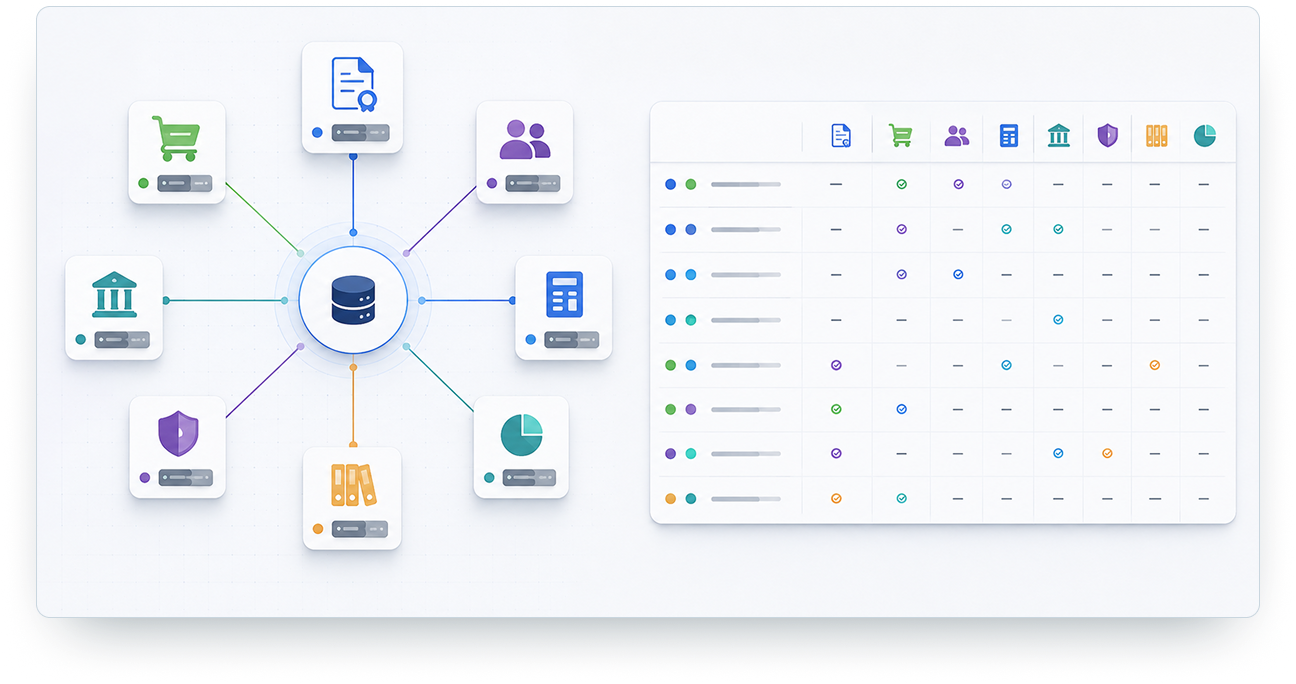
One decision, four authoritative systems
A cross-border vendor payment connected to a contract obligation, tax treatment, procurement approval, treasury position, and evidence requirement. Every source keeps its owner.

Relationships across systems — not records inside one module
Each node names the system that owns it. The relationship table is always present as the accessible alternative.
Controls that run at the decision, not beside it
This is the difference most often mistaken for a configuration setting. The distinction is not whether controls exist — it is whether they are resolved for this action, this entity, and this jurisdiction at the moment of the decision.


The audit trail is an output of the work, not a project after it
Where documents, logs, approvals, and reports vary by implementation, the manifest is a defined object: it links the source records, the policy reasons, the reviewers, the decisions, the changes, and the outcomes to one action.
Designed for reviewable, attributable evidence. This is not a claim of legal admissibility or independent audit certification.
Entity hierarchy, policy overlays, and coverage status as first-class objects
Where localization capability varies by product and configuration, this model is explicit: every jurisdiction claim carries a coverage status, a source authority, and a review date.

Bounded decision support, not an assistant with authority
Where AI capability varies by product and release, the distinction here is the boundary: authorized sources, permission scope, uncertainty disclosure, human review, and an audit record separate from the proposal.

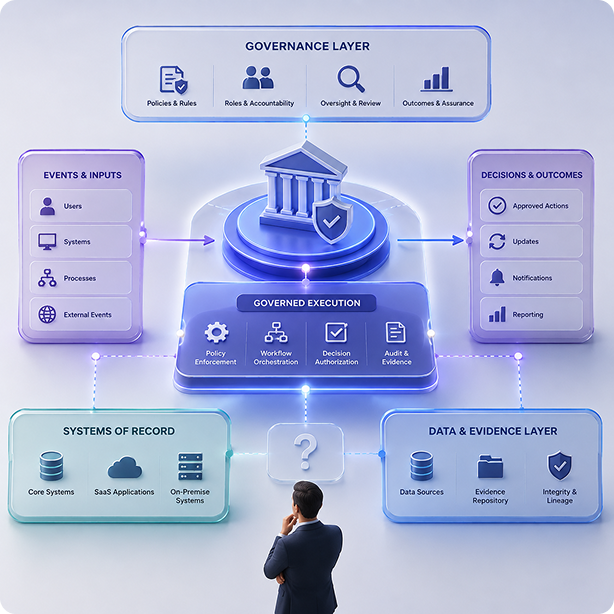
Designed to work with your systems, not around them
Four layers. ZoikoSuite becomes authoritative for governance decisions and evidence — not for every record in the estate.
ERP / finance · HCM / payroll · banking / treasury · tax / filing · contract / legal · procurement · CRM / commerce · identity · data platforms · industry systems.
APIs · webhooks · files and batches · event streams · connectors · service identities · scopes · schema and version control · retries · reconciliation.
Business operations graph · governance control plane · workflows and approvals · jurisdiction intelligence · evidence · governed AI · analytics and reporting.
Decision records · evidence manifests · obligations · exceptions · reporting — authoritative inside ZoikoSuite.

Which system owns which record — stated, not assumed
A record may have one authoritative source but many governed relationships and evidence references. Ambiguous ownership triggers implementation review; it is not resolved automatically.

A record may have one authoritative source but multiple governed relationships and evidence references. ZoikoSuite becoming authoritative for a decision does not make it authoritative for the underlying transaction.
The payment row above is marked review required deliberately: execution ownership between ERP and banking differs by organization and must be resolved during implementation rather than assumed by the platform.
All four are legitimate. None is the mature endpoint.
The appropriate outcome may differ by function, entity, jurisdiction, process, and implementation phase — and one organization can hold all four at once.
Complement
Keep existing systems and add governed workflows, authority, evidence, exceptions, and cross-functional intelligence around selected actions.
Coordinate
Orchestrate processes and decisions across multiple authoritative systems through controlled integration and event handling.
Consolidate selected processes
Move overlapping workflows, policy controls, approvals, evidence, and reporting into ZoikoSuite while retaining required systems of record.
Replace selected scope
Replace a bounded process, module, or system only when functional, data, control, integration, evidence, security, operational, and rollback criteria are approved.
Complement
The ERP remains authoritative for the invoice, the ledger, and the payment record. ZoikoSuite adds the authority check, the jurisdiction rule, the segregation control, the evidence requirement, and the decision record around the release — and writes nothing back until a decision permits it.
- Which actions currently lack a complete authority context
- Where evidence is assembled manually after the fact
- Which cross-functional consequences are handled by email
- Whether any system of record needs to change at all
Keeping your ERP can be the target architecture
Retaining a system of record is a deliberate design decision, not an unfinished migration.
Ledger and subledgers
The ERP stays authoritative for the general ledger, subledgers, and statutory reporting where that serves the organization.
Inventory, manufacturing, order management
Deeply embedded operational modules with mature configuration remain in place; ZoikoSuite governs the decisions that cross them.
Recent or in-flight implementation
An organization mid-program can add governed coordination without disturbing the system it has just deployed.
Invoice and payment record created
The ERP remains authoritative. The record is created and matched in the system that owns it.
Context and policy evaluated
Entity, jurisdiction, contract obligation, authority limit, segregation rule, and evidence requirement resolve for this specific payment.
Authorized decision recorded
A named approver with a verified limit decides. The decision, the reason, and the evidence become an authoritative ZoikoSuite record.
Execution and update
The write is issued to the ERP on the authorized version only, with an idempotency key. Retries cannot duplicate the payment.
Evidence manifest and reporting
Read-back reconciliation confirms the ERP state. Variance opens a reconciliation record rather than closing the action.

Consolidating workflows and controls — not master data
This is workflow and control consolidation. It is not transaction-system or master-data consolidation, and it does not delete legacy records.
- Manual approvals across email and chat
- Obligation tracking in spreadsheets
- Policy exceptions agreed verbally, recorded inconsistently
- Evidence assembled at audit time from four systems
- Cross-functional cases coordinated in tickets
- Two overlapping workflow tools
- Local spreadsheets holding approval limits
- Configured governed workflow with named owners
- Source-system links replacing re-keyed data
- Authority and approval controls enforced at the decision
- Evidence manifest built during the work
- Explicit exception states with expiry and review
- One reporting surface across the consolidated scope
- Approval limits held in the authority model
This checklist is not a self-certification. Each criterion requires an accountable owner's confirmation.

Replacement is a governed implementation decision
A replacement unit is a clearly bounded process, module, workflow, record domain, integration, entity, or jurisdiction scope — never "the stack."
Non-guarantee. Replacement suitability and timing require customer-specific discovery, validation, contracting, and implementation approval. Nothing on this page constitutes a commitment that any system can or should be replaced.
Freeze and transition plan
Change freeze window agreed with every affected function and communicated.
Migration
Data moved or referenced according to the approved ownership decision.
Reconciliation
Balances, counts, and control totals reconciled and signed off.
Shadow Mode evidence
Comparison results reviewed; unresolved differences dispositioned by an authorized owner.
Activation
Bounded scope activated with all thirteen gates approved or formally excepted.
Monitoring and exception support
Heightened monitoring, named support, and daily exception review during the stabilization period.
Rollback window
Defined period during which the pre-cutover path can be restored under the approved plan.
Business owner · system owner · control owner · security · privacy · data owner · implementation lead · qualified professional where required. No automated readiness score substitutes for owner approval.
Evaluate around your operations before anything changes
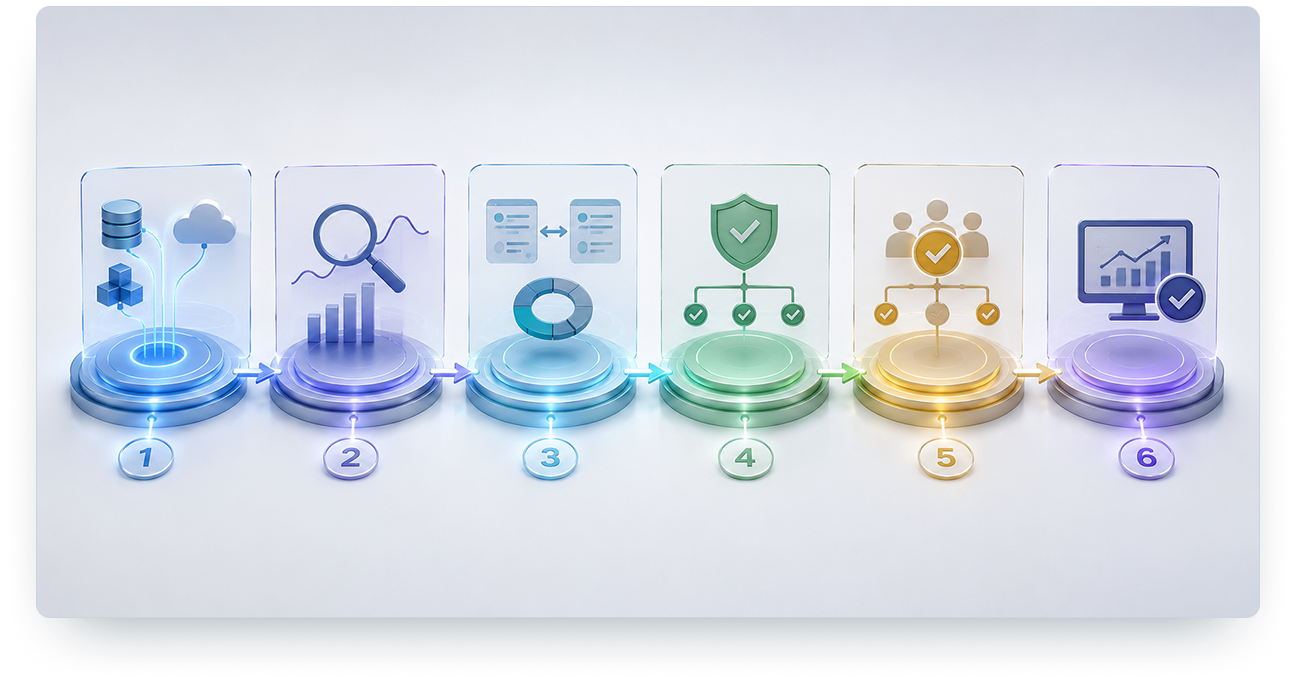
Six phases. Shadow Mode observes real events and compares proposed governance with current outcomes — without authorizing production actions.
Discover
Map processes, records, systems, owners, controls, evidence, integrations, and gaps.
Model
Configure context, controls, roles, workflows, evidence requirements, and boundaries.
Shadow Mode
Compare proposed governance against current outcomes with execution disabled.
Disposition
An authorized owner resolves every difference before anything is marked ready.
Controlled activation
Activate bounded scope with gates approved and rollback defined.
Expand and assure
Add scope, monitor exceptions, validate evidence, review controls.
Diligence routes for the teams who will ask
Every claim carries its status. Certification marks are absent until independently verified and approved.
- Zero Trust
- Identity and access
- Encryption and key management
- Application / API security
- Incident response
- Business continuity
- Compliance overview
- SOC 2 readiness
- ISO 27001 alignment
- GDPR / CCPA controls
- Data Processing AgreementPDF · new tab
- Subprocessors
- Retention
- Responsible AI
- Accessibility
- Evidence architecture
- Audit trails
- Policy decisions
- Manifests
- Internal controls
- Segregation
- Reporting
- Residency
- Regional hosting
- Private / single-tenant
- Sovereign / on-premise
- Key options
- Recovery
- Architecture Library
- Integration guide
- Migration guide
- API documentation
- Deployment options
- Documentation
- System status
- Support
- Release notes
- Training
Discuss where governed execution belongs in your architecture
Bring your entity list, your system inventory, and your approval matrix. We will work through which of the four target-architecture outcomes fits which part of your estate.
Built for multi-entity, multi-jurisdiction, regulated, and operationally complex organizations.
Category, coexistence, and replacement
Direct first sentences, then qualified detail. Every answer is present in the page source.
No. ZoikoSuite is not positioned as a conventional ERP; it is designed around governed execution across functions, systems, entities, jurisdictions, authority, evidence, and governed AI.
Conventional ERP products generally organize transactional modules and records, and individual products vary widely in the governance, workflow, analytics, and AI they include. See the comparison snapshot